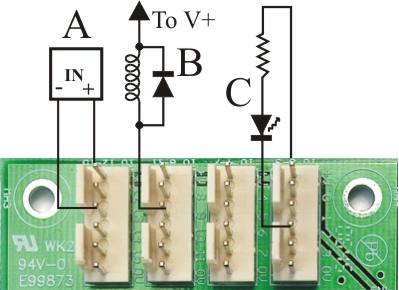
The picture above illustrates the bidirectional I/O points connected to some typical output loads. When an output is ON it connects the I/O pin to 0V via a Darlington transistor.
Each of the fours connectors is wired to 4 bidirectional I/O pins. Each connector also has a "convenience" pin connected to power supply positive. The output load should always be connected between the output pin and power supply positive. Use the Supply+ convenience pin in preference to wiring directly to the power supply +.
CAUTION: Take care never to short an output pin to the positive common pin. If the output is on at the time you will blow up the output chip instantly!
The loads illustrated are:
A: The input pins of a solid state relay. Note the polarity!
B: A relay coil. Notice we have included a catch diode across the coil. While there are diodes on the board we strongly recommend a diode across the coil, as close as possible to the coil, to minimize problems with switching noise. A suitable diode is a 1N4001 or similar 1A/50V rectifier diode.
C: An LED, with a series current limiting resistor. Resistance calculators
You will (of course!) have noticed that for A and C we returned the loads to V+ by way of the convenience outlet pins on the boards, whereas for B we have shown the connection to be to V+ elsewhere (presumable directly to the power supply). There are two reasons for this:
The (digital) outputs are implemented using the ULN2803A, a chip that contains Darlington transistors. The outputs consist of transistor switches between the output pin and 0V. When the output transistor is off, a multimeter set to DC volts connected between the output and 0V will measure a voltage slightly less than the positive supply voltage.
Take care never to short the output pin to the positive supply voltage. If the output turns on the output chip will be instantly destroyed. This includes never doing it with a multimeter set on a current range.
There are catch diodes built into the chip. This means the board will not be damaged if you are driving relay coils, solenoid valves or other inductive loads (within the ratings of the output). We nevertheless recommend external catch diodes connected directly to the relay coil as close as possible to the relay, in order to reduce adverse effects of switching noise. The onboard diodes also mean that the load must not be connected to a supply voltage greater than the board's positive supply voltage.
The maximum allowable output current is 400mA steady state, with brief (100mS) peaks of 500mA allowed. There is also a limit to how much total current one ULN2803A chip can handle. This relates to the internal heating of the chip.
Let's look at 2 extreme cases:
The following table lists allowable current versus ambient temperature, when all 8 outputs are conducting the same current at once:
| Temperature | Allowable current per output |
|---|---|
| 25°C | 180mA |
| 40°C | 160mA |
| 50°C | 145mA |
| 60°C | 130mA |
| 70°C | 115mA |
The following table shows the maximum allowable currents, when concentrated in a few outputs, versus temperature
| Temp | 1st O/P | 2nd O/P | 3rd O/P | 4th O/P |
|---|---|---|---|---|
| 25°C | 400mA | 400mA | 300mA | 0 |
| 40°C | 400mA | 400mA | 150mA | 0 |
| 50°C | 400mA | 400mA | 0 | 0 |
| 60°C | 400mA | 325mA | 0 | 0 |
| 70°C | 400mA | 220mA | 0 | 0 |
Naturally there are many other possible combinations, but the above should serve as a guide.
The above figures are intended as a guide only. In any event, the absolute maximum operating temperature for the ULN2803A chip is 70°C.
If you feel like doing the actual sums, here's the procedure.
This calculation aims at a maximum internal (junction) temperature of 125°C, which is the maximum rating of the chip. There are 2 things to keep in mind with this:
Hence, an occasional excursion to, or even above, the rated temperature isn't the end of the world. However, for long life the cooler the better.
Note: This discussion pertains to the maximum operating temperature for the ULN2803A output chip only. See CC18 Operating temperature ratings for a further discussion.
Here are some of the ways you can blow up the outputs: